
Why decisions stall
Why more vendor research does not produce better decisions
Most teams buy from the list they made before evaluating anything. That is where the decision actually happens.
Bogdan Andronic, Co-founder & CEO

The work is real, and most of it happens before anyone speaks to a vendor
A complex business purchase now runs through a group, not a person. Gartner puts that group at five to sixteen people across as many as four functions, each bringing their own priorities to it. Anyone who has sat in the meeting where those priorities get reconciled recognises the description on sight.
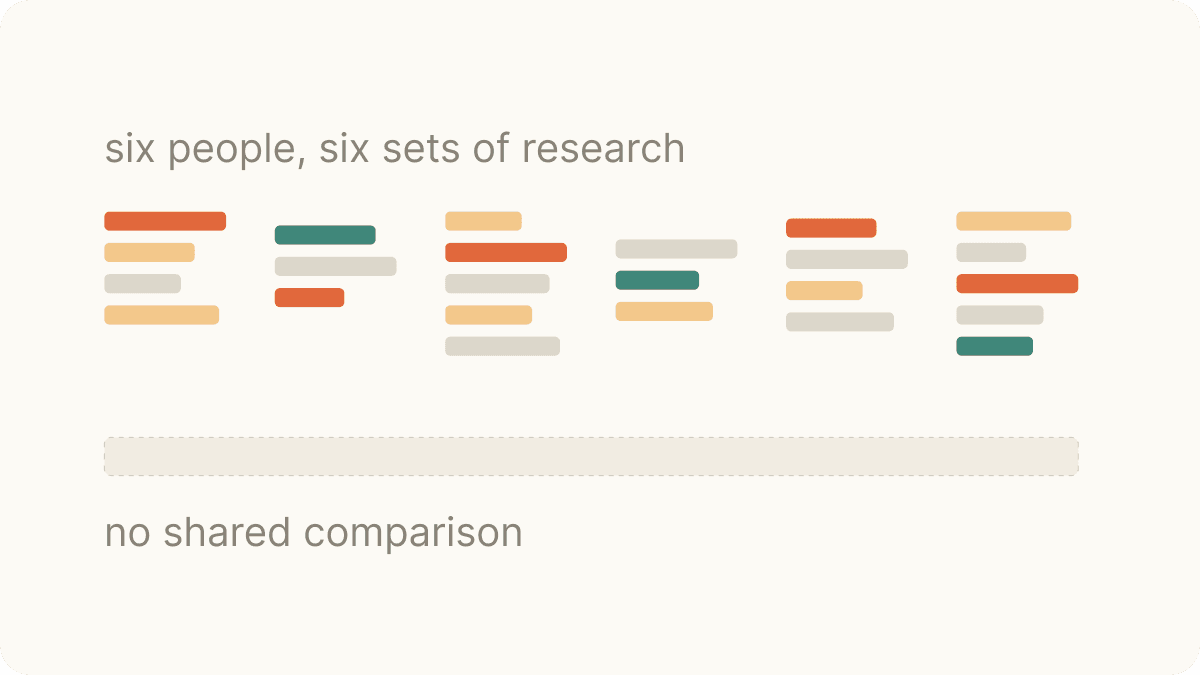
Nobody in that room has seen the whole picture. One person read the review sites. Finance pulled pricing. IT looked at the security page. Someone talked to a peer at another company who uses one of the options. Each person is holding a fragment, and the meeting is where you discover the fragments disagree.
The instinct at that point is to research harder. More sources, more options, more thorough. It is a reasonable instinct, and the evidence does not support it.
Why does vendor research take so long?
Because gathering has no natural stopping point.
You can always read one more review, open one more pricing page, book one more demo. Nothing in the process tells you when you have enough. So you stop when the quarter ends, or when the budget window closes, or when you are simply tired of the question.
Meanwhile the material decays. The comparison spreadsheet built in week one is missing the two options that turned up in week three. Someone joins the project in week four and asks why a particular vendor was ruled out, and nobody wrote down the reason, so you go back and check. That is not carelessness. It is what happens when a process has no structure to hold its own conclusions.
The result is a lot of work that feels rigorous and produces very little resolution.
More time does not produce better outcomes
Here is the finding that should end the argument for thoroughness on its own.
57% of buyers who were satisfied with their software purchase finished evaluating in three months or less. 54% of the buyers who ended up regretting the purchase took five months or more. That comes from Capterra's 2025 Tech Trends Survey, which ran across more than 3,500 businesses.
Two honest caveats. This is a correlation, not a mechanism. The likely explanation is not that hurrying improves judgement. It is that buyers who moved quickly did so because they already knew what they were looking for, and buyers who took five months were circling because they did not. And Capterra is a software directory, so it has a commercial interest in how people research software. It is worth knowing that.
It is not the only place the pattern shows up, though. A separate Gartner survey of 1,120 respondents all involved in evaluating or selecting large enterprise technology purchases, found that the organisations reporting high regret had taken, on average, seven to ten months longer to complete the purchase. Different sample, different year, same direction.
What the finding does rule out is the idea that time is the missing input. Adding months to an evaluation is not what separates the decisions people are glad about from the ones they are not.
The decision is usually made when the shortlist is formed
Now the number that reframes everything above it.
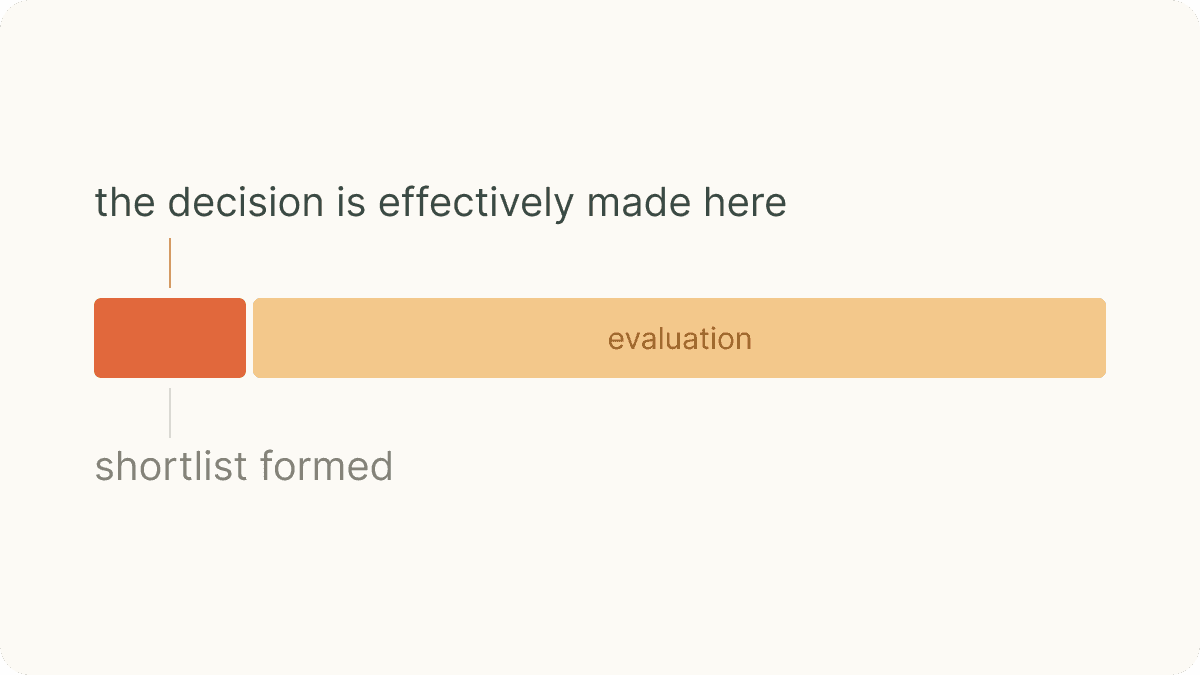
Nearly every software buyer builds an initial list of vendors. 91% of them go on to buy from that list almost always or most of the time. And those purchases end in regret 60% of the time. That is from Capterra's US Tech Trends report.
Read it slowly. The list gets built first. The list almost always contains the eventual winner. The outcome is bad more often than it is good.
Which means the months of comparison that follow are not choosing the vendor. The list already did that. What the comparison produces is a reason for the choice, which is a different job and a considerably easier one.
So where does the list come from? Search results. A review site's category page. A peer recommendation. Whichever vendor's rep reached someone first. Those are all reasonable sources of names, and not one of them knows your stack, your constraints, your budget, or the thing that will break in month four.
What separates the buyers who are happy
The same Capterra research compared successful buyers against regretful ones, and the differences have nothing to do with effort.
60% of regretful buyers made the decision alone, against 48% of successful ones. Successful buyers finished with a shorter shortlist, around three products against nearly four, because they were more willing to cut options that did not actually fit. And they were markedly more open to revising the initial list to include a vendor they had not first considered.
None of those is "look at more vendors". They are about who is in the room, and about how willing you are to change the list once you know what you are looking for.
The same body of research is worth reading for why people regret purchases, not only how often. Gartner Digital Markets, which publishes the Capterra surveys, reported that the leading product-related reasons for regret were higher-than-expected total cost, at 33%, and slow or difficult implementation, at 32% as covered here. Both of those are knowable before you buy. Both get missed when nobody wrote down what mattered, because a criterion that was never stated is a criterion nobody checked.
What changes when the structure comes first
Three things, in this order.
Criteria before the list. Decide what the purchase has to do before you look at who sells it. This is the only step that changes which options you consider, rather than which one you pick from options someone else assembled.
Weights before the comparison. Not every requirement carries the same weight, and the moment you say so out loud, the trade-offs become arguable instead of assumed. Two people who disagree about a vendor usually agree about the facts and disagree about the priorities. Weights move that argument to where it belongs.
The same evaluation for every option. Every candidate measured against the same criteria, in the same way, including the incumbent and including the one someone already likes. Consistency is what makes the result mean anything.
To be clear about what this is not: it is not an argument for less research. It is an argument that gathering and deciding are two different activities, and that most teams spend heavily on the first while doing almost none of the second. Structure does not replace the research. It tells you when the research is finished. If you want the full version of that process, we wrote it up as a nine-step framework for researching and comparing business options.
Where MercatIQ fits
This is the sequence MercatIQ is built around. You describe what you are buying and what it has to do. The criteria get proposed, and you edit them until they are yours. You set the weights. Only then does the research run.
What comes back is not a list of options to start filtering. It is a set of options already scored against the criteria you set, with the reasoning visible for each one, so the first thing you look at is a comparison rather than a starting point.
The research itself takes minutes rather than weeks. The only thing that reliably extends a session is deciding to change your own criteria partway through, which is the thinking the whole process exists for.
We have an obvious interest in this argument, which is why none of the numbers above are ours. If you want to see it run on a decision you are actually facing, tell us what you are evaluating.
Common questions
How long should a vendor evaluation take?
Shorter than most teams assume. Capterra's data shows 57% of satisfied software buyers finished in three months or less, while 54% of regretful buyers took five months or more. Duration is not the thing to optimise, though. Buyers who move quickly do so because their criteria are clear. Get the criteria right and the timeline takes care of itself.
Why do so many software purchases end in regret?
Because the shortlist is usually built before anyone defines what the purchase has to do. 91% of buyers purchase from the initial list they assembled, and those purchases go wrong 60% of the time. The most common reasons buyers give are cost higher than expected and implementation harder than expected, both of which are checkable in advance if someone thought to make them criteria.
Does comparing more vendors lead to a better decision?
No. Comparing more options against no defined criteria produces more information and no more clarity. Comparing fewer options against explicit, weighted criteria produces a result you can explain. The number of candidates matters far less than whether every candidate was measured the same way.
Should you build a shortlist before or after setting criteria?
After. A shortlist built first constrains the decision to whatever a search engine, a review site or a sales rep put in front of you, and the evidence says buyers almost never leave that list once it exists. Criteria first means the list is a consequence of your requirements rather than a substitute for them.
How many vendors should you evaluate?
Enough that a genuinely different kind of answer is represented, which in most categories is somewhere between three to five. The useful test is not the count. It is whether you could explain, using your own criteria, why each one is on the list and why anything else is not.
Related articles
Aug 26, 2026
·
Structured buying
Most vendor comparisons get assembled from browser tabs, a spreadsheet and a chat window. Each is good at part of the job and none of them is good at the decision.

Aug 26, 2026
·
Team alignment
The analysis is the easy half. Getting six people from four departments to accept the same conclusion is where vendor decisions actually break down.

Aug 19, 2026
·
Structured buying
Nine steps that turn scattered research into a scored comparison your team can defend, from defining scope to documenting the decision.

Not the decision you are trying to make?
Tell us what you are evaluating. We will show you how MercatIQ builds the criteria, runs the research, and scores the options.