
Team alignment
How to present a vendor comparison your team will actually agree with
Nearly three in four buying groups end up in conflict. What you show them, and the order you show it in, decides which conflict you get.
Daniel Brinzas, Founder & CPO

The comparison is finished and the group still does not agree
Before MercatIQ I spent years in engineering leadership, and I sat in this meeting more times than I can count. Project management tooling. Team chat. The work suite. Later the AI coding assistants and the feature flag platforms. Different categories, the same room every time. Someone had done the research properly, the comparison was on the screen, and the group still could not agree.
This is not a rare failure. Gartner surveyed 632 B2B buyers in August and September 2024 and found that 74% of buying teams show what it calls unhealthy conflict during the decision: members holding conflicting objectives, disagreeing on the right course of action, or being overruled by someone outside the group. The same research found that groups which do reach consensus are 2.5 times more likely to say the deal was a good one.
Gartner also puts the size of a modern buying group at five to sixteen people across as many as four functions. That is the room. Agreement in it is not the formality that follows the analysis. It is the harder half of the work, and almost nothing has been written about how to do it from the inside, because most advice on buying group consensus is written for the salespeople trying to influence it.
Disagreement about vendors is rarely disagreement about facts
Nobody argues for long about which tool has which feature. That is checkable, and it gets checked in the first five minutes.
The argument is about whether the feature matters. Security weights risk. Finance weights total cost over three years. Operations weights how long implementation takes and who has to do it. Each of them is right about their own part of the business, and each of them is holding a different implicit ranking of what the purchase is for.
So when you present a winner, you are not presenting a fact. You are presenting the output of a ranking that lives in your head and that nobody else has seen. The group senses this immediately, and the meeting turns into an argument about your conclusion. That argument has no natural end, because nobody is actually disagreeing about the thing they are discussing.
The version of the conversation you want is an argument about priorities. That one has an end, because priorities can be written down, compared, and settled.
Show the criteria before you show the result
The order you present in decides which argument you get.
Lead with the recommendation and everyone in the room works backwards from it, checking whether the conclusion matches what they already believed. People who agree stop paying attention. People who disagree start hunting for the flaw. Neither group is evaluating your reasoning.
Lead with the criteria and the group has a different job: accept the frame or correct it. That is a much easier thing to ask, because at that point no conclusion is at stake and nobody has to lose. Once the criteria are agreed, the result stops being your opinion and becomes what the criteria produce.
The practical version of this is simple. Send the criteria and the weights around before the meeting, not the comparison. The meeting is then about whether anything is missing, and the ranking is something you look at together afterwards rather than something you defend.
Put the weights on the table
Weights are where the real disagreement lives, so make them visible and make them arguable.
When someone objects to the result, the useful response is not to defend the result. It is to ask which weight they would change and by how much. That turns a vague objection into a specific number, and a specific number can be tested in front of everyone.
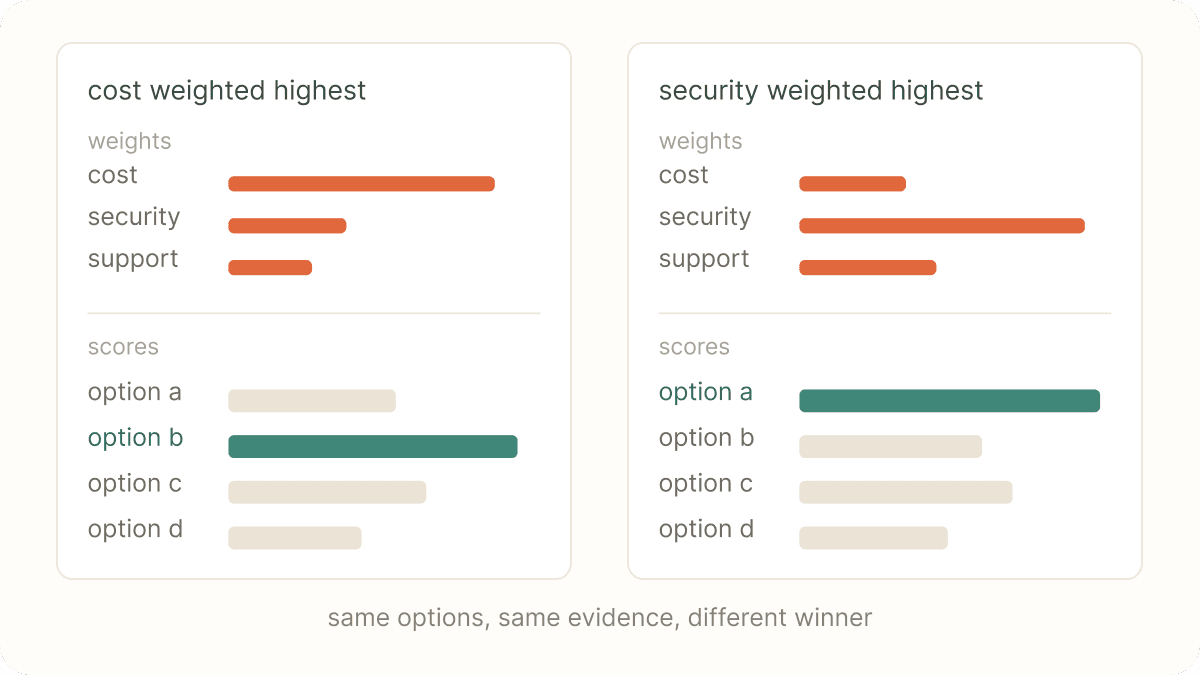
Then test it. Move the weight to where they want it and see what happens.
Two outcomes, both good. Either the ranking changes, in which case the group has learned something genuinely important about how finely balanced the decision is, or the ranking does not change, in which case the objection has been answered without anyone having to concede anything. I have watched arguments that had been running for two weeks end in about ninety seconds this way.
Score every option the same way, including the one someone already likes
The fastest way to lose the room is to let one option skip the process.
It is usually the incumbent, because renewing feels like not making a decision. Sometimes it is the tool that someone used at a previous company and liked. Sometimes it is whichever vendor got a meeting first and was persuasive in it. That option arrives with a head start and quietly never gets measured against the same bar as the rest.
Everyone notices. And once one option is exempt, the whole comparison reads as a justification for a choice that was already made, which is exactly what it will be.
Score the incumbent. Score the favourite. If they win on the agreed criteria, they win properly and the decision is stronger for it.
Alignment is set up long before the meeting
By the time you are presenting, most of the alignment work should already be done.
Capterra's research found that 60% of regretful software buyers made the decision alone, compared with 48% of the successful ones. The buyers who were happy with the outcome more often assembled a group spanning IT, the people holding the budget, and the people who would end up using the thing every day.
There is a reason for that. If the first time your colleagues see the criteria is in the room where you also show them the answer, you are asking them to approve a frame and a conclusion in the same breath. People push back on that, and they are right to.
Bring them in earlier, at the point where the criteria are being written. Their input costs almost nothing there and changes everything downstream. It also means that by the time you present, they are not reviewing your decision. They are looking at the result of theirs. If you want the full process that leads up to that point, we set it out in our framework for researching and comparing business options.
Where MercatIQ fits
I built MercatIQ because I got tired of running this meeting badly.
The criteria and the weights are the shared object. Everyone can see what was measured, how heavily it counted, and what each option scored against it. When someone disagrees, you change the weight and look at what happens together, in the room, instead of going away for a week to rebuild a spreadsheet.
The comparison is also something you can send. People who could not attend see the same criteria, the same weights and the same reasoning as the people who did, which removes an entire category of argument that only exists because two people were working from different versions of the truth.
If you have a decision stuck in this exact place, tell us what you are evaluating.
Common questions
How do you get stakeholders to agree on a vendor?
Agree on the criteria before you show anyone a result. Most disagreement about vendors is disagreement about priorities wearing a disguise, and priorities can be discussed productively while conclusions cannot. Gartner found that buying groups reaching consensus are 2.5 times more likely to call the outcome a high-quality deal, so this is worth real effort rather than being the last item on the agenda.
What should you include when presenting a vendor comparison?
The criteria, the weight on each one, every option scored against all of them, and the reasoning behind each score. Include the options that lost and the incumbent you did not choose. A comparison that only explains the winner is a recommendation, and people treat recommendations as opinions.
What do you do when one stakeholder disagrees with the result?
Ask which criterion they would weight differently and by how much, then apply it and look at the outcome together. Either the ranking changes, which is information the whole group needed, or it does not, which answers the objection without anyone having to back down.
Should you share your shortlist before the meeting?
Share the criteria before the meeting. The shortlist is better looked at together, because the criteria are what you want people to challenge and a list invites them to challenge names instead. Sending the ranking in advance tends to produce private positions that then have to be defended in public.
Who should be involved in a vendor decision?
Anyone who can block it, anyone who has to live with it daily, and anyone accountable for the budget. Gartner puts typical buying groups at five to sixteen people across up to four functions. You do not need all of them in every conversation, but each of them should have seen the criteria before the decision is made, because the alternative is discovering their objection at the end.
Related articles
Aug 26, 2026
·
Structured buying
Most vendor comparisons get assembled from browser tabs, a spreadsheet and a chat window. Each is good at part of the job and none of them is good at the decision.

Aug 25, 2026
·
Why decisions stall
Buying groups spend months comparing options and still regret the purchase. The data says the failure happens earlier than anyone looks.

Aug 19, 2026
·
Structured buying
Nine steps that turn scattered research into a scored comparison your team can defend, from defining scope to documenting the decision.

Not the decision you are trying to make?
Tell us what you are evaluating. We will show you how MercatIQ builds the criteria, runs the research, and scores the options.