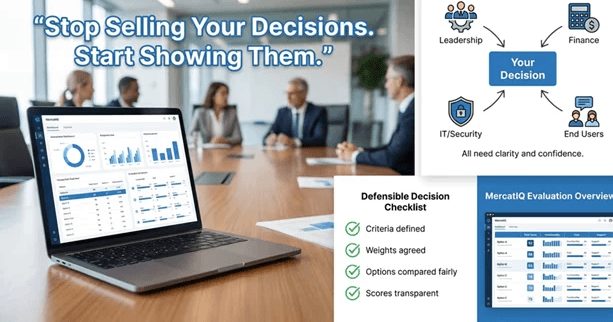
1. The Hidden Friction: Defending Decisions, Not Just Making Them
If you’ve ever led a tool selection, vendor search, or supplier evaluation, you know the work doesn’t end when you feel confident.
You still have to bring everyone else along.
Leadership wants to know if it aligns with strategy.
Finance wants to understand cost and ROI.
IT and security want to assess risk.
End users want reassurance that you picked something that actually helps them.
Without a clear structure for showing your reasoning, every conversation becomes slower, more repetitive, and more frustrating than it needs to be.
2. Why “I Did My Research” Isn’t Enough Anymore
Saying “I did my research” used to be enough.
Today, budgets are tighter, stakes are higher, and there’s more scrutiny on big decisions. Stakeholders expect clarity on:
What options you considered
How you compared them
Which criteria mattered most
Why the chosen option came out ahead
Building consensus and confidence in your recommendations is easier when supported by a clear, consistent process, rather than relying on a spreadsheet, subjective scoring, or a simple compilation of links.
That’s a hard sell in any organization.
3. What a Defensible Decision Actually Looks Like
A defensible decision has three components:
Explicit Criteria
Everyone knows what matters: e.g., reliability, implementation time, integrations, price, support, compliance.
Weights and Trade-offs
Criteria are not all equal. Maybe reliability is 30%, cost is 20%, security is 20%, and so on. The trade-offs are out in the open.
Consistent Evaluation
Every option is measured against the same criteria in the same way. No one vendor gets a free pass because their website looked better.
With these pieces in place, it’s much easier to explain, “This is why we chose Option A”, grounded in objective data rather than personal preference.
4. How MercatIQ Helps You Build Decisions Others Can Trust
MercatIQ is built to address this exact problem.
Instead of you manually cobbling together a justification after the fact, the platform helps you structure the decision from the beginning:
Clarify Criteria & Weights
You define what matters or let MercatIQ help suggest relevant factors based on what you’re buying.
Search & Enrich Options
MercatIQ searches the web for relevant products, services, or suppliers and enriches their data.
Normalize & Evaluate
It normalizes that data so you can compare options fairly, then evaluates each one against your criteria.
Score & Explain
You get a clear score for each option and a breakdown of how it performed on each criterion.
Now your “defense” is built into the process.
5. Example: Choosing a Vendor and Presenting It to Stakeholders
Imagine you’re selecting a new analytics platform.
Your criteria:
Data security & compliance – 25%
Integration with existing stack – 25%
Scalability & performance – 20%
Total cost of ownership – 15%
Support & onboarding – 15%
MercatIQ aggregates and enriches a set of potential platforms and scores them against these criteria.
You present the comparison:
Platform A – 8.8/10 (strongest on security and integrations)
Platform B – 8.2/10 (cheaper, but weaker integrations)
Platform C – 7.9/10 (good performance, weaker support)
When leadership asks, “Why Platform A?” you can say:
“Because we agreed security and integrations were our top priorities. Platform A scores best there, even though it isn’t the cheapest. Here’s the scoring breakdown.”
Instead of a debate about personal preferences, you have a discussion grounded in criteria, weights, and data.
6. Long-Term Benefits: Trust, Speed, and Repeatable Process
When you adopt this kind of structured, transparent approach, you get more than just one good decision:
Faster alignment – less back-and-forth, fewer long email threads.
Higher trust – people see the logic, not just the conclusion.
Repeatable process – you can use the same approach for future decisions.
Better documentation – you can look back and understand why a choice was made.
Over time, this builds a culture where decisions feel fair, transparent and data backed.
7. Try It on Your Next Decision
On your next product, service, or supplier search, try this:
List your criteria and assign simple weights.
Use MercatIQ to search, enrich, and evaluate options.
Share the scored output with stakeholders early.
You’ll likely find the conversation shifts from “I don’t agree with your choice” to “Let’s tweak the criteria to better reflect our priorities.”
That’s a better conversation to have.